

Hong Kong’s economy is expected to grow up to 3.5 per cent as government coffers return to a surplus following a streak of deficits, Financial Secretary Paul Chan has announced in his 2026 budget speech.

Hong Kong’s economy was “buoyant” last year, as external trade remained strong, private consumption rebounded, and fixed investment accelerated, Chan said, forecasting a 2.5 to 3.5 per cent growth in Hong Kong’s economy in the current 2025-26 fiscal year.
“In the medium term, protectionism will persist in some major economies, while fragmentation of the global economy will continue. Nevertheless, the rise of the Global South and the reshaping of the global trade and investment landscape will unlock new markets and new growth areas,” Chan said.
He also announced that the surplus in the 2025-26 financial year ended a three-year deficit streak.
Driven by demand for electronics, total exports of goods from Hong Kong grew 12 per cent, with notable increases in exports to mainland China and Association of Southeast Asian Nations (ASEAN) countries.
Visitor arrivals increased by 12 per cent, while private consumption spending rose by 1.7 per cent for the fiscal year.
See also: LIVE: Hong Kong Budget 2026
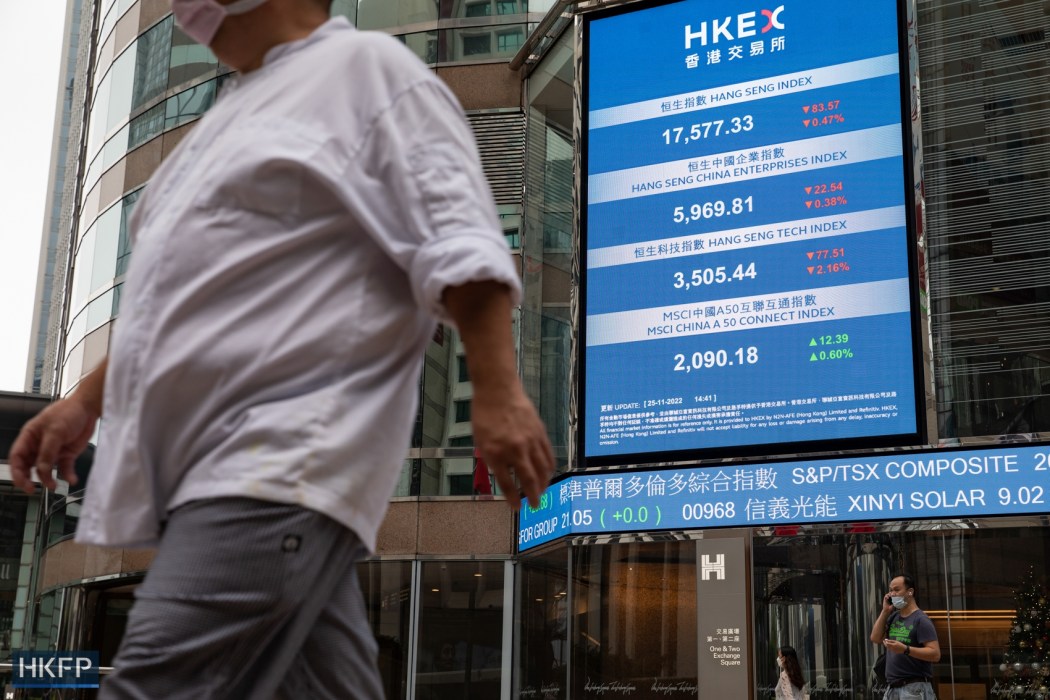
Meanwhile, the stock market delivered a “stellar performance,” Chan said. The Hang Seng Index rose by 28 per cent over the year, while initial public offerings (IPOs) raised HK$280 billion, ranking first globally.
The property market also rebounded, with increases in both prices and transaction volume.
Total transactions reached a four‑year high of nearly 63,000 for the year, while property prices rose by 3.3 per cent, ending a three-year decline, and rental prices rose by 4.3 per cent.
In the black
Chan also said that the government’s tax revenue has increased “as a result of the booming economy and capital market,” and, along with a fiscal consolidation programme, the government’s finances have improved “sooner than expected.”
The government’s operating account, which covers regular government spending and revenue, has returned to a surplus, Chan said.
The city logged a HK$80.3 billion deficit in the 2024-25 fiscal year, marking the third shortfall in a row, after recording an HK$101.6 billion deficit in 2023-24 and a HK$122 billion shortfall in 2022-23.

Chan also vowed to align the city’s financial plans with Beijing’s 15th Five-Year Plan. “The stable and high‑quality development of our country is always our strongest backing,” he said.
“Our country’s sustained high-standard two-way opening-up, coupled with scientific and technological innovation, has presented us with new opportunities.”
Despite favourable conditions for exports and domestic demand as well as expectations of interest rate cuts, the “international environment remains complex and intricate,” Chan also said.
“With the major advanced economies still frequently shifting their trade and economic policies, uncertainties will continue to loom over global trade. A slower‑than‑expected pace of US rate cuts could hamper the optimism currently underpinning the global financial market,” he added.