

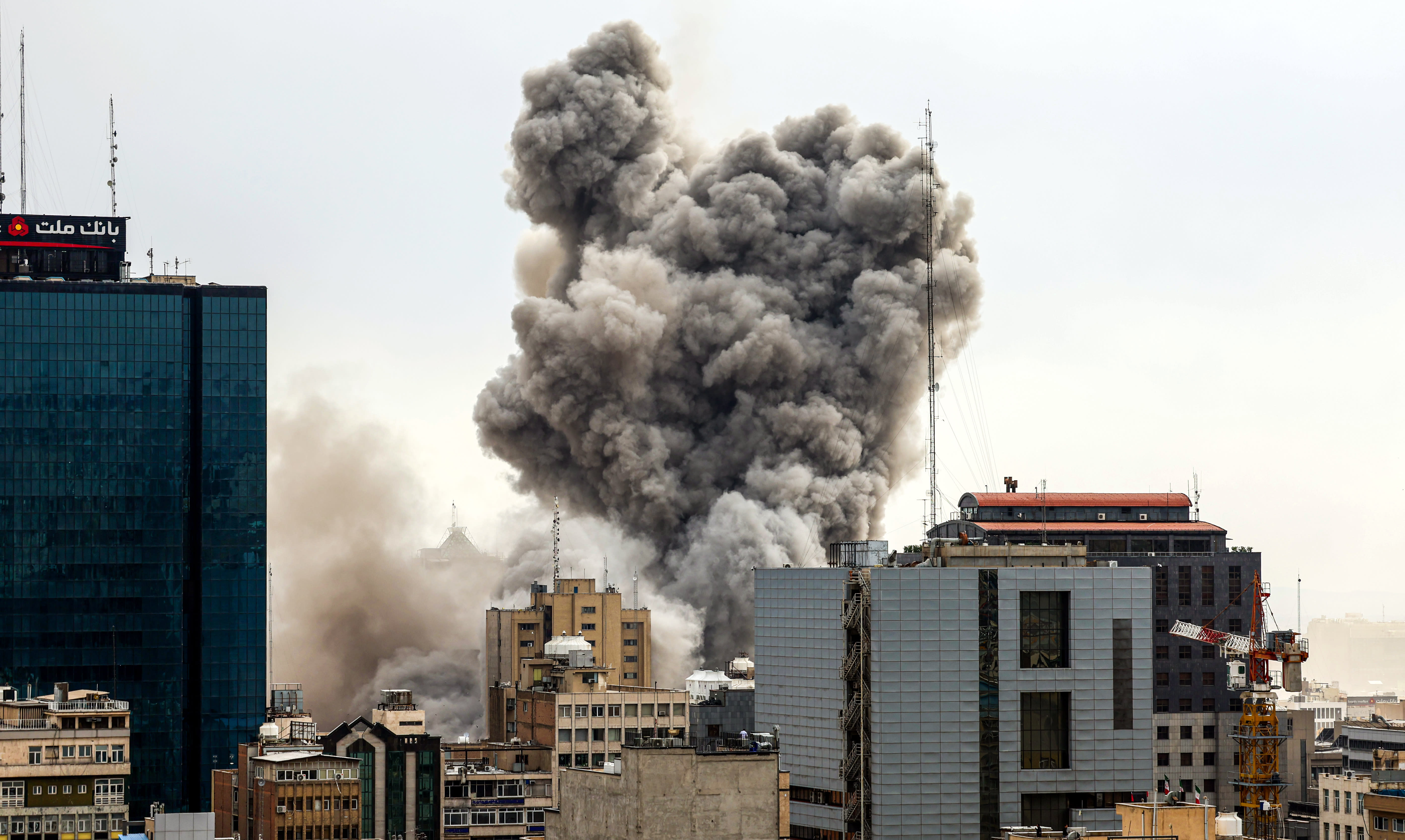
Heavy bombing of Iran as war enters its third day. Strikes kill major Iranian leaders. Mass civilian casualties as Israel and the U.S. strike in the center of Tehran. Medical facilities in Tehran and Ahvaz damaged, and Iran says a nuclear facility was attacked. U.S. strikes across Iran include attack drones for the first time. Iran retaliates with major offensive against Israel and U.S. bases and military sites across the Gulf, and in Cyprus. Four U.S. service members killed. Three U.S. fighter jets shot down; Iran claims it downed at least one, while U.S. says it was friendly fire. At least ten killed at demonstration at U.S. consulate in Karachi. Oil facilities attacked, prices soar. President Donald Trump’s estimate of the length of the war shifts from “days” to “weeks.” Top Iranian officials signal Iran’s willingness to fight, defend retaliation. U.S. and Israel burning through munitions. China backs Iran’s self-defense.
Israel pounds Lebanon, killing 31, after Hezbollah fires rockets. Lebanon’s prime minister demands ban on Hezbollah operations. Israel uses Iran war as a pretext to halt already limited aid to Gaza. Israel blocks movement in the West Bank.
Congress to vote on War Powers Resolution. Sen. Tim Kaine, on the Senate Foreign Relations Committee, says no imminent threat justified war with Iran. Rashida Tlaib, AOC denounce U.S.–Israeli strikes and call for Congress to act. First anti-war ad of the midterm election cycle. Dark money–funded think tanks pushed regime change. Sen. Bernie Sanders unveils billionaire tax.
169 killed in attacks in South Sudan. Afghanistan says it fired on Pakistani jets as border fighting intensifies. Russian tanker bound for Cuba is drifting in the North Atlantic. Argentine Senate approves Javier Milei’s anti-labor reform.
In case you missed it, Drop Site’s weekend coverage of the Iran war:
This is Drop Site Daily, our free daily news recap. We send it Monday through Friday.
War on Iran
Heavy bombing of Iran as war enters its third day: Multiple airstrikes hit Tehran on Monday as the U.S.-Israeli war on Iran expands. Tehran’s streets have been largely deserted with people sheltering during airstrikes. On Sunday, the Israeli military launched a new wave of attacks targeting what it described as the “heart of Tehran,” with the Associated Press reporting a major explosion near a police headquarters, a state television building, the Revolutionary Court, and a Defense Ministry building. Al Jazeera said an army hospital and other government sites were also struck. Also on Sunday, Mehr News Agency reported that 20 people were killed in a strike on Niloufar Square, a densely populated residential and commercial area in Tehran’s District 7.
Strikes kill major Iranian leaders: President Donald Trump on Saturday announced that Iran’s Supreme Leader Ayatollah Ali Khamenei had been targeted and killed. Khamenei’s daughter, son-in-law, grandchild, and a daughter-in-law were also killed in the strikes. Iranian state media on Sunday also announced the deaths of Chief of Staff Abdolrahim Mousavi, Defense Minister Aziz Nasirzadeh, Supreme National Defense Council Secretary Ali Shamkhani, and Islamic Revolutionary Guard Corps head Mohammad Pakpour.
While Trump touted the intelligence operation that tracked Khamenei’s movements, an Iranian official tells Drop Site the Supreme Leader refused extra safety measures: “[The Supreme Leader] insisted on keeping things as normal and ordinary as possible, without seeking extra security measures or standing out in any way.” Read the full report, from Jeremy Scahill and Murtaza Hussain.
Mass civilian casualties from U.S.-Israeli airstrikes: In the deadliest recorded attack of the war, an airstrike on Saturday morning struck a girls’ elementary school in Minab, a small city near the Strait of Hormuz, killing 165 people, according to the state-run IRNA news agency, many of them schoolgirls between seven and 12 years old. It was unclear if it was a U.S. or Israeli strike. On Saturday, CENTCOM’s spokesperson said they were “looking into” the reports. Hours later, an airstrike hit the main sports hall in Lamerd, a city near the Persian coast, as dozens of teenage girls were attending their regular training sessions. Additional strikes hit two nearby residential areas and a hall adjacent to a school. At least 18 people were killed, including many teenage girls. Read Drop Site’s on-the-ground reports from Minab and Lamerd.
Iran’s casualty counts: At least 555 people had been killed in Iran, according to the Iranian Red Crescent. An earlier report had 747 injured, though the toll is expected to be an undercount. Over 130 cities across the country have come under attack, the Red Crescent said, with strikes hitting 24 of the country’s 31 provinces.
Medical facilities in Tehran and Ahvaz damaged as civilian toll mounts: Iran’s Red Crescent Society said its Comprehensive Rehabilitation Center in Tehran’s Seyed Khandan neighborhood was seriously damaged in strikes, with photos showing shattered treatment rooms. On Sunday, Iran’s Health Ministry said Gandhi Hospital in Tehran was struck and Abuzar Hospital in Ahvaz was hit and evacuated, while damage was also reported at Khatam and Motahari hospitals in Tehran and three emergency bases in Sarab, Chabahar, and Hamedan. Officials said 21 patients were transferred after the Ahvaz strike and two emergency medical personnel were injured.
Iran says nuclear facility attacked: Iran’s Ambassador to the International Atomic Energy Agency said that U.S.-Israeli airstrikes targeted the Natanz enrichment facility on Sunday. “Again they attacked Iran’s peaceful safeguarded nuclear facilities yesterday. Their justification that Iran wants to develop nuclear weapons is simply a big lie,” Reza Najafi told reporters at the IAEA headquarters in Vienna
U.S. strikes across Iran include attack drones for the first time: U.S. CENTCOM said on Saturday its early strikes targeted IRGC command centers, air defenses, missile and drone launch sites, as well as military airfields. It also reported the use of low-cost one-way attack drones in combat for the first time. Its ballistic missile attacks hit areas near Tehran, Tabriz, Isfahan, and Shiraz, according to the Associated Press, and Israel assisted in choosing targets and carrying out the attacks.
Iran’s major offensive against U.S. bases and Israeli military sites: Iran responded to the Saturday attacks by unleashing a series of sustained missile and drone attacks against Israel and U.S. military facilities across the Persian Gulf, striking the United Arab Emirates, Bahrain, Saudi Arabia, Kuwait, and Qatar. Iran also targeted Jordan, Oman, Kuwait, Iraq, and Cyprus. The Islamic Revolutionary Guard Corps described its offensive operation as the most intense in its history. At least 11 people were killed in Israel, along with three in the UAE, two in Iraq, one in Bahrain, and one in Kuwait.
Iranian missiles hit Israel: Israel declared an immediate nationwide state of emergency after launching the war on Iran, with Defense Minister Israel Katz announcing school and workplace closures and the Israel Defense Forces Home Front Command ordering civilians to remain near shelter. Over the weekend, Iran fired ballistic missiles at Israel, including strikes on Tel Aviv, west Jerusalem, and Beit Shemesh, where nine people were killed in a residential building collapse, while additional fatalities brought the nationwide death toll to 11 and injuries to 456, according to the Health Ministry.
Four U.S. service members killed: The U.S. military said a fourth service member has been killed since the start of the operation against Iran. On Sunday, CENTCOM announced that three soldiers had been killed and five were seriously wounded—the fourth, announced Monday, “succumbed to their injuries.” The soldiers killed had been deployed to a base in Kuwait supporting the operation, U.S. officials told NBC News.
Three U.S. fighter jets shot down; Iran claims it downed at least one, while U.S. says it was friendly fire: The U.S. military said Kuwait “mistakenly shot down” three American F-15 fighter jets during a combat mission while attacks from Iranian aircraft, ballistic missiles, and drones were underway. Iran claimed it shot one of them down. U.S. Central Command said all six pilots ejected safely and are in stable condition.
Iranian strikes hit airport and military sites in Kuwait: An Iranian drone struck Kuwait International Airport on Sunday, injuring several workers and damaging Terminal 1, according to Kuwait’s Civil Aviation Authority. Kuwait hosts major United States military facilities, including Camp Arifjan and Ali Al Salem Air Base. Overnight into Sunday, further explosions were reported, with the IRGC claiming Ali Al Salem Air Base was put “out of service.” Black smoke was later seen rising from inside the U.S. Embassy in Kuwait City, which issued a shelter-in-place order as air raid sirens sounded.
At least ten killed at demonstration at U.S. consulate in Karachi: In Karachi, Pakistan, demonstrators breached the outer wall of the U.S. Consulate in a protest over the war in Iran—following which security forces opened fire after parts of the compound and nearby police posts were set ablaze. Two more people were killed in a separate demonstration near the U.S. Embassy in Islamabad. The embassy issued a high-level security alert as unrest in the country continued. At least 35 people have been killed and hundreds more wounded across Pakistan during nationwide protests though total casualty figures remain disputed.
Fires and drone attacks reported at U.S. facilities in Iraq: A fire was reported Saturday at the U.S. airbase at Erbil International Airport in northern Iraq following an Iranian strike, and by Sunday, the Iraqi Shiite militia Saraya Awliya al-Dam had claimed responsibility for a drone attack on U.S. forces at Baghdad International Airport in retaliation for the killing of Khamenei. As of late Sunday, there were no confirmed U.S. or civilian casualties from the Iraq incidents.
Suspected drone strike hits UK base in Cyprus: Around midnight Monday, March 2, the British Ministry of Defense confirmed a suspected Iranian drone strike caused minor damage at RAF Akrotiri, a UK base in Cyprus, with no injuries reported. The incident followed Prime Minister Keir Starmer’s statement that Britain would permit the United States to use its bases for limited defensive purposes, including targeting Iranian missile launchers, while London, Paris, and Berlin said they were prepared to take proportionate defensive action but were not involved in the initial offensive strikes. Reports suggested RAF Fairford and Diego Garcia could also be made available as the conflict widens.
Strikes in Bahrain: On Saturday, reports circulated that an Iranian drone struck the Crowne Plaza complex in Manama’s Diplomatic Area, near key government buildings, though Bahraini authorities did not immediately confirm damage or casualties. Early Monday, explosions were heard across the capital as Iranian missiles targeted sites in Bahrain, according to The Guardian, with footage appearing to show a direct impact inside a U.S. military facility. Bahrain hosts the United States Navy’s Fifth Fleet headquarters.
Thousands stranded as air travel disrupted: Iran also hit civilian airports in Kuwait, Bahrain, Abu Dhabi, and Dubai and airspace over much of the region remained closed on Monday. Major regional airports—including Dubai International, Sharjah, Abu Dhabi, and Hamad International Airport in Doha—have suspended operations. More than 3,400 flights have been cancelled in the first few days of the conflict, and an estimated 300,000 people are currently stranded across the Gulf region, according to the Associated Press. Semafor reported that a limited number of private flights out of Riyadh are running the wealthy up to $350,000.
Oil facilities attacked, prices soar: On Sunday, at least four oil tankers were struck or damaged in and around the Strait of Hormuz after Iran declared the waterway closed to international navigation. Saudi Arabia’s Ras Tanura oil refinery, one of the largest in the world came under a drone attack on Monday, and was temporarily shut down. Qatar’s Defense Ministry said two drones struck energy facilities in the industrial city of Ras Laffan and Mesaieed with no reported casualties. QatarEnergy said it would stop its production of liquefied natural gas after the attacks. Oman said an oil tanker was attacked by an explosive-laden boat in the gulf of Oman on Monday. Earlier in the day, debris fell on Kuwait’s Ahmadi oil refinery, injuring two workers, after drones were shot down, the state-run KUNA news agency reported. Meanwhile, Chevron said it has been instructed by Israel’s Energy Ministry to temporarily shut down production at the Leviathan gas field. Oil prices surged to a 52-week high on Monday.
Trump’s estimate of the length of the war shifts from “days” to “weeks”: On Saturday, Trump claimed on Truth Social that military action was justified because Tehran tried to interfere in the 2020 and 2024 U.S. presidential elections. On Saturday and Sunday, Trump said U.S. strikes on Iran would continue until American objectives were achieved, warning Iranian security forces to surrender while urging citizens to rise up. He offered varying timelines for the war, running from “two or three days” to “four to five weeks” and acknowledged further U.S. casualties were likely. Trump told Axios, The Atlantic, and The New York Times that he sees potential “off ramps” and has agreed to talks with Tehran. On Sunday, President Trump told ABC the U.S. had identified possible candidates to take over Iran after the death of Khamenei and other members of the country’s senior leadership, but that all of them were killed in the weekend’s strikes. “The attack was so successful it knocked out most of the candidates,” Trump said. “It’s not going to be anybody that we were thinking of because they are all dead.”
Top Iranian official Larijani signals Iran’s willingness to fight: Ali Larijani, the current secretary of Iran’s Supreme National Security Council and one of the most influential figures within the Iranian government, made several public statements about the Iranian government’s unwillingness to bend in the face of U.S. and Israeli aggression. On Saturday, he vowed “retaliation” that would make “Zionist criminals and the shameless Americans regret their actions.” He stressed that the casualties suffered were “very low” in the eyes of the Iranian government, and said that the armed forces of the country were experienced and ready for further aggression.
On Sunday, Larijani underscored the posture that the government intends to take, saying unequivocally: “We will not negotiate with the United States.” Earlier Sunday, Aragchi said, “They must explain why they launched this aggression. After the attacks stop and they provide an explanation, we will consider how to respond.”
Iranian foreign minister defends retaliation: On Saturday, Araghchi said in calls with counterparts in Saudi Arabia, the United Arab Emirates, Qatar, Kuwait, Bahrain, and Iraq that U.S. and Israeli strikes were a “flagrant violation of the fundamental principles of the United Nations Charter”, and warned that any territory used to launch attacks on Iran would be treated as a legitimate target. In interviews with NBC and ABC News, Araghchi said Iran was acting in self-defense against U.S. military bases being used to attack it and insisted Tehran would respond “whatever it takes.” When asked by American reporters why Iran carried out several strikes on U.S. bases over the weekend, Aragchi responded accordingly: “We are under an attack from you. This is obvious. This is a very simple fact,” he told NBC.
U.S. and Israel burning through munitions: Limited U.S. and Israeli interceptor stockpiles are influencing planning, the Financial Times reported, noting the Pentagon has ordered fewer than 650 THAAD interceptors since 2010 and could burn through large quantities quickly in a sustained exchange, after expending up to 150 during last year’s 12-day war with Iran. Officials told the paper that “magazine depth” may constrain the scope or duration of operations and force trade-offs affecting U.S. commitments in Ukraine and the Indo-Pacific.
China backs Iran’s “self-defense”: Chinese Foreign Minister Wang Yi told Iranian counterpart Abbas Araghchi in a phone call that Beijing supports Tehran in “defending its sovereignty, security, territorial integrity, and national dignity,” following U.S.-Israeli attacks that have killed hundreds since Saturday. Wang also “urged the US and Israel to immediately cease military operations, avoid further escalation of tensions and prevent the conflict from spreading to the entire Middle East region.”
Attacks on Lebanon
Israel pounds Lebanon, killing 31, after Hezbollah fires rockets: At least 31 people were killed and over 140 wounded in Israeli attacks on Lebanon late Sunday and Monday after Hezbollah fired a barrage of rockets at northern Israel. It marked the first major violation of the ceasefire by Hezbollah since it took effect in November 2024. Over that period, Israel has bombed Lebanon on a near daily basis and committed over 15,000 ceasefire violations, according to the UN. Hezbollah said it launched “advanced missiles” and a swarm of drones at the Mishmar al-Karmel missile defense site south of Haifa, calling the strike retaliation for the killing of Iran’s Supreme Leader Ayatollah Ali Khamenei and for ongoing Israeli operations in Lebanon. Israel launched strikes across southern Lebanon and on the capital of Beirut. Tens of thousands in southern and eastern Lebanon are estimated to have fled their homes after the Israeli military ordered residents of 50 towns and villages to evacuate. The Israeli military threatened to invade Lebanon and Israeli defense minister Israel Katz said Hezbollah Secretary-General Naim Qassem is now a “target for elimination.” Qassem succeeded longtime leader Hassan Nasrallah after he was assassinated by Israel in September 2024.
Lebanon’s prime minister demands ban on Hezbollah operations: Lebanon’s prime minister Nawaf Salam said Hezbollah’s military activities are “illegal acts” and demanded the group hand over its weapons. He said rocket fire from southern Lebanon was an “irresponsible and suspicious act” that threatens national security. “We prohibit Hezbollah’s military activities and confine its role to the political sphere, and we demand that the military institutions implement this,” Salam said.
The Gaza Genocide and the West Bank
Casualty counts: Over the past 24 hours, at least one Palestinian was killed and five wounded in Israeli attacks across Gaza. The total recorded death toll since October 7, 2023 has risen to 72,097 killed, with 171,796 injured. Since October 11, the first full day of the so-called ceasefire, Israel has killed at least 630 Palestinians in Gaza and wounded 1,698, while 735 bodies have been recovered from under the rubble, according to the Palestinian Ministry of Health.
Israel closes Gaza crossings and halts aid staff rotations: The Israeli military has reimposed a total closure on Gaza, shutting all crossings, including Rafah, “until further notice” COGAT said humanitarian staff rotations are postponed, preventing aid workers from entering or leaving the enclave. Israeli authorities claimed the aid already present in the area would suffice for an extended period even though Israel has only allowed in a fraction of the agreed-upon aid since the ceasefire went into effect. Food prices immediately soared in Gaza with Palestinians rushing to markets for basic goods. World Central Kitchen founder José Andrés warned the organization will run out of food this week. The group is currently preparing about 1 million hot meals per day, according to their estimates.
Israel blocks movement in the West Bank: Israeli forces began enforcing strict restrictions on movement for Palestinians across the occupied West Bank on Saturday as it launched its war on Iran. Some 1,000 checkpoints and entrances to cities, towns, and villages have been closed until further notice, paralyzing daily life.
United States
By Julian Andreone, with Ryan Grim. Have a tip on Capitol Hill? Email Andreone at Julian@dropsitenews.com.
Congress to vote on War Powers Resolution: The Senate currently plans to vote Tuesday, and the House on Wednesday, on a resolution that would put lawmakers on record on whether to limit Trump’s war on Iran. In the House, opponents of the war are actively pressuring Democratic leaders Hakeem Jeffries and Katherine Clark to whip support for the measure rather than advise members to vote however they want—referred to as a “vote of conscience” on Capitol Hill. On Saturday, Jeffries said the Trump administration must immediately explain its decision to strike Iran and clearly define its national security objectives. He also urged the White House to articulate a plan to avoid another costly and prolonged military incursion in the Middle East.
“This is not a vote of conscience, this is a vote about the Constitution and Article 1 responsibilities for members of Congress,” Rep. Pramila Jayapal told Drop Site. In the first year of the Trump administration, Jeffries and Clark have largely refrained from exerting discipline over the Democratic caucus, allowing significant defections beginning with the Laiken Riley Act, which set the stage for Trump’s violent mass deportation policy. The resolution from Democratic Rep. Ro Khanna and Republican Thomas Massie is being publicly opposed by three Democrats: Josh Gottheimer of northern New Jersey, Thomas Suozzi of Long Island, and Greg Landsman of Cincinnati. Republican Warren Davidson, also of Ohio, however, has signaled he may break ranks and support it.
First anti-war ad of the midterm election cycle: Voters in Texas and North Caroline go to the polls on Tuesday in closely-watched primaries. In North Carolina’s fourth district, AIPAC is secretly funneling money through a PAC linked to Hakeem Jeffries to boost incumbent Valerie Foushee, who won in 2022 thanks to an influx of more than $2 million from AIPAC. She is facing a rematch from Durham County Commissioner Nida Allam. Allam on Monday launched an ad condemning the Iran war; it will air during the Duke-N.C. State basketball game Monday night. In it, Allam slams Foushee for taking money from defense contractors and an AI company used by the Pentagon in the attack. (Ironically, that firm, Anthropic, is being pushed out by War Secretary Pete Hegseth, but in the meantime it is spending more than $1.5 million dollars backing Foushee.) In Texas, polls have Democrat James Talarico slightly ahead of Jasmine Crockett in the Senate primary, while Attorney General Ken Paxton holds a slight lead over incumbent Republican Sen. John Cornyn. The GOP primary is likely to head to a very expensive runoff. If the ethically challenged, scandal-plagued Paxton emerges the primary winner, Democrats feel they have a genuine chance at flipping the seat.
Rashida Tlaib, AOC denounce U.S.–Israeli strikes and call for Congress to act: On Sunday, Rep. Rashida Tlaib issued a sweeping condemnation of the U.S.–Israeli attack on Iran, calling it an “illegal war of aggression” that has already killed children and risks igniting a catastrophic regional conflict. She accused President Trump of ignoring public opposition to a new war, criticized U.S. sanctions policy, and rejected the framing of the campaign as promoting democracy, saying “you cannot ‘free’ people by killing them.” Tlaib urged Congress to reconvene to assert its war powers and stop further escalation. Representative Alexandria Ocasio-Cortez called President Donald Trump’s strikes on Iran “unlawful” and “unnecessary” and said she would vote “Yes” on the measure.
Sen. Tim Kaine says no imminent threat justified war with Iran: Sen. Tim Kaine said on CNN that, based on the classified information he’s seen, there was no imminent threat from Iran to the United States that would justify sending American forces into another war, and he criticized the strikes as lacking legal authority. Kaine, a member of the Senate Foreign Relations Committee, has introduced the parallel War Powers Resolution in the Senate. “Trump administration officials acknowledged in closed-door briefings with congressional staff on Sunday that there was no intelligence suggesting Iran planned to attack U.S. forces first,” Reuters confirmed.
Sen. John Fetterman backed strikes, even as Oman said diplomacy was close: On Sunday, Senator John Fetterman defended President Donald Trump’s decision to strike Iran, telling CNN that Trump had tried to negotiate firm agreements barring Tehran from acquiring nuclear weapons but that Iran refused (a misstatement of the facts, according to the Omani Foreign Minister). “Remind everybody…you are never allowed to acquire nuclear weapons, and clearly they was,” he said.
Dark money–funded think tanks pushed regime change: Conservative dark money networks funneled millions into think tanks advocating regime change, including the Center for Security Policy and the Foundation for the Defense of Democracies. Donors Trust, tied to conservative legal strategist Leonard Leo and funded in part by billionaire Barre Seid, gave more than $2.7 million to the Center for Security Policy between 2020 and 2023, while the Sarah Scaife Foundation, financed by the Mellon oil fortune, provided over $1.6 million to the Foundation for the Defense of Democracies during the same period. The groups have publicly urged the Iranian public to overthrow its government and warned of threats to the United States. Report from The Lever available here.
Sen. Bernie Sanders unveils billionaire tax: Jeff Stein in the Washington Post reports that Sanders is proposing a mega-tax on America’s roughly 1,000 billionaires, a levy that would raise a staggering $4.4 trillion and looks to reshape the conversation around wealth and inequality. The tax would pay for $3,000 stimulus checks to everyone earning less than $150,000 a year and also go toward proving universal child care, reducing health insurance premiums, expanding Medicaid, and requiring Medicare to cover vision, hearing, and dental, among other investments in housing and education. Potential Democratic presidential candidate Ro Khanna called it a “bold economic proposal” and said he would be working with Sanders on it.
LEAKED Email: Kat Abughazeleh “firmly an interventionist,” foreign policy adviser said: Kat Abughazaleh, a socialist Democratic candidate in Illinois’ 9th District and one of the only Palestinian-Americans seeking office in 2026, was described by her national security adviser as “firmly an interventionist” who “won’t stop until Russia is made to pay for its crimes,” in written responses detailing her foreign policy vision, obtained by Drop Site. Abughazaleh subsequently said the email’s content was unauthorized and the individual was no longer on her staff. She said the advisor misrepresented her as an “interventionist,” while reiterating her support for arming the Ukrainian people, and eliminating “strategic ambiguity” with respect to China/Taiwan. The full leaked email is here.
Other International News
169 killed in attacks in South Sudan: At least 169 people, including 90 civilians, were killed in South Sudan on Monday after militants raided a village in Abiemnom county, a remote area of the country, according to the Associated Press. The U.N. Mission in South Sudan said in a statement that 1,000 people sought shelter with its base after the attack. The killings are part of an escalating wave of violence gripping South Sudan as forces loyal to President Salva Kiir battle armed groups believed to be loyal to opposition leader Riek Machar.
Afghanistan says it fired on Pakistani jets as border fighting intensifies: Afghanistan’s Taliban administration said it carried out air defense attacks against Pakistani aircraft over Kabul on Sunday, after explosions and gunfire shook the capital, according to Reuters. Heavy fighting has escalated between the countries along the 2,600-kilometer border, with a Pakistani official declaring that they were at “open war” last week.
Russian tanker bound for Cuba is drifting in the North Atlantic: The Russian tanker Sea Horse, believed to be carrying about 200,000 barrels of diesel for Cuba, was diverted on February 25 and is now drifting in the North Atlantic to avoid potential U.S. enforcement action, Bloomberg reports. Although the Treasury Department said oil resales benefiting Cuba’s private sector would be permitted, infrastructure constraints and few reported deliveries—about 150 barrels per day versus roughly 22,000 barrels needed for basic operations—suggest that the shortfall will persist.
Argentine soldier detained in Venezuela released after more than a year: An Argentine soldier, Nahuel Gallo, who had been held in Venezuela since late 2024, has been released and has already left the country, Reuters reported.
Argentine Senate approves Javier Milei’s anti-labor reform: On Friday, Argentina’s Senate approved a sweeping labor reform backed by President Javier Milei, with the bill passing 42–28 with two abstentions. The overhaul weakens worker protections, including the right to strike, and unions say that the employer-funded severance scheme it creates could affect pension resources. Read more on this bill from Drop Site contributor Sam Carliner.
More from Drop Site
DOJ records show Epstein role in Gates Foundation polio work in Pakistan: Newly released United States Department of Justice documents detail Jeffrey Epstein’s involvement in the Bill and Melinda Gates Foundation’s anti-polio campaign in Pakistan from 2013 to 2018. Emails show Epstein positioning himself as a gatekeeper between the foundation and the International Peace Institute, and receiving confidential field reports that included sensitive information about Taliban contacts, Pakistani military operations, and references to North Atlantic Treaty Organization activity. The disclosures, which come as Bill Gates publicly acknowledges and regrets his past association with Epstein, risk further inflaming mistrust of vaccination campaigns in Pakistan, where polio eradication efforts have long been entangled with intelligence operations and regional conflict. The latest on Pakistan from Waqas Ahmed and Murtaza Hussain here.
On Saturday, Jeremy Scahill and Ryan Grim discussed Trump’s launch of the war on Iran with guests Ali Abunimah of The Electronic Intifada and Iranian-American writer Hooman Majd, Jeremy and Ryan discussed the roots and potential futures of the conflict in Iran. That livestream is here:
Jeremy Scahill joined Hasan Piker’s livestream to discuss Iran. His appearance is here:
Ryan Grim joined Rania Khalek on BreakThrough News on Saturday to discuss the war on Iran, with a particular eye to the way U.S. domestic politics might forge its path. Here:
Programming note: You can sign up here to get updates from us on our WhatsApp channel.
If you want to continue getting this newsletter, you don’t have to do anything. But if this is too much—we do try to be mindful of your inbox—you can unsubscribe from this newsletter while continuing to get the rest of our reporting. Just go into your account here at this link, scroll down, and toggle the button next to “Drop Site Daily” to the off setting. It looks like this:
